Sunday, June 13, 2010

Petřín and the Observation Tower

What a glorious day for a stroll through the park.  Petřín anyone?

Petřín is a hill in the center of Prague that rises some 130 km above the left bank of the Vltava River.  The hill, almost entirely covered with parks, is a favorite recreation area for Praguers.  I'd like to go to the Petřín Lookout Tower...yes, that's the one that resembles the Eiffel Tower! 

I like to take the Petřín funicular to the top of the hill.  Not because the walk is steep, that I don't mind at all.  Actually, the walk is quite nice... passing through gardens and even an apple orchard.  I just want to ride the  funicular because I find it to be fun!  Let's pick it up on Ujezd Street...

...And get on board!
The funicular has three stops:  Ujezd at street level; Nebozizek is the middle station and there's a great restaurant there where you can kick back and enjoy the views; and Petřín at the top of the hill.  Since we're going to the tower, we'll go straight to the top.  

Interesting tidbit:  According to Czech legend, the name of the middle station stems form an incident in which Emporer Charles IV, requesting food, was unable to properly pronounce the Czech words "nebo řízek" (meaning, "or schnitzel").  Mmm, řízek...

The funicular was originally opened in 1891, but closed with the start of the First World War in 1914.  The current longer track opened in 1932, and operated through the Second World War.  In 1965, Earth movement caused suspension of the service, and it did not resume until 1985.  At that time new cars were provided and the track was reconstructed, but the original machinery remained.  

 I'm terribly afraid of heights, but apparently the view is spectacular.  So I'm going to look my fear in the face and head on up the tower... gulp!

Petřín lookout tower is 60 meters high (that's 196.85 feet), which makes it five times smaller than the Eiffel Tower.  Although it's much shorter than the Eiffel Tower, it stands atop a sizable hill, thus the top is actually at a higher altitude than that of the Eiffel Tower.  The tower was built in 1891 and was used as an observation tower as well as a transmission tower.  

Ready to climb its 299 steps?  Or you can take the elevator, but I'm climbing...see you at the top!

The beginning of the climb wasn't so bad because the stairs are walled in.  No pics of the rest of the climb because, well, let's just say my fear of heights got the best of me.  
Alex on the other hand has no fear...

There are two viewing platforms... here's the view from the first one


Can you believe we were just down there?

Some commie looking stuff...


And here's the view from the very top.  
Well worth the climb (299 steps seems like a lot, but it took maybe 5 minutes and wasn't bad at all!)

They said it would be spectacular, and it truly is!  

Apparently, on a clear day you can see Snezka, the highest peak in the Czech Republic, which is 150 km from the tower


I did it, I conquered my fear of heights!  Errr, well not really, but I climbed, I saw, and I survived!

Right next to the tower is this cute castle-like building.  Can you guess what it holds?  A labyrinth!  

Built in 1891 for the Jubilee Exhibition in Prague

The exhibition was meant to celebrate the 100-year anniversary of the first industrial exhibition in Prague in 1791.  It comprised a showcase of Czech industry and acquainted visitors with the monuments and notable sights of our country whilst promoting the development of tourism.

This pavilion's main attraction was a dioramic picture entitled "Battle with the Swedes on Charles Bridge", which took place ion 1648.  This recalled events at the end of the Thirty Years War when the Swedish army invaded Prague

After the exhibition ended, this pavilion was transferred to Petrin Hill in 1892.  The following year, it was turned into a mirror labyrinth along the lines of the Prater in Vienna.

Not a difficult labyrinth by any stretch of the imagination...I was hoping for one similar to that in The Shining, but fun nonetheless...

The Hall of Mirrors rocks!


Hahahha that was fun and good for a laugh!  Shall we stroll through the park and make our way towards the Strahov Monastery and Hradcany?  The views along the way are magnificent!


Now that we've had a nice, leisurely stroll through the park, let me show you one last thing before we head off for a pivo and a bite...

Hunger Wall (Hlavova Zed)
Dating back to the 14th century, this wall stretches from Strahov across Petřín Park to Ujezd.  You can see it from the observation tower we were just in, but alas I don't seem to have a photo of it (I blame that damn fear of heights!).  

The Hunger Wall was built by order of the Holy Roman Emperor and Czech King, Charles IV, between 1360-1362.  It is said that Charles IV built this wall to help the poor in Prague during time of terrible famine.  The poor working on the structure received food for themsleves and their families, and although old records prove that the Czech lands did indeed suffer from great famine in the 1360's, building the wall was probably only a strategic act.  

This wall used to serve as the fortification of the southern part of Lesser Town and Prague Castle from the west or south for more than 500 years (1362-1848).  Today, only about 1200 meters have remained from the original length of the wall, which is about 6 meters high and almost 2 meters wide.  Its inner walkway is protected by battlements and a platform for marksmen.   

I hope that you enjoyed our day in the park!!!


Happy name Day, Antonín! Všechno nejlepší k svátku!

Today we honor Antonín.  Happy name Day, Antonín!
Antonín is of Latin origin and widely used in the Czech language.  It is the Czech form of Anthony, which means "priceless; inestimable".

Saturday, June 12, 2010

Happy Name Day, Antonie! Všechno nejlepší k svátku!

Today we honor Antonie.  Happy Name Day, Antonie!
Antonie is the Czech form of Anthony.  Its origin is Latin and its meaning is "priceless; inestimable".

Antonie holds a very special place in my heart as that was my grandmother's name.

Friday, June 11, 2010

Petrin

I promised to bring you to Petrin today, and will do my best to do so...

Happy Name Day, Bruno! Všechno nejlepší k svátku!

Today we honor Bruno.  Happy Name Day, Bruno!
Bruno is of Old Germanic origin and derived from the element brun, which means "brown". Brun is an old form of Bruno.  The name was originally bestowed upon people with brown hair eyes, or complexion.

Happy Belated Name Day, Gita! Všechno nejlepší k svátku!

Yesterday we honored Gita.  Happy Belated Name Day, Gita!
Gita is of Celtic, Sanskrit, and Old Greek origin, and its meaning is "song".  In addition, in Czech, Gita is a short form of Brigita, which is of Celtic origin.

Wednesday, June 9, 2010

The Strahov Monastery...and spectacular views of Prague!

Yesterday I took you to the Strahov Monastery Brewery (hope you enjoyed it!), thus I thought that today might be a good day to visit the Monastery itself.  I also have a little surprise for you... one of the best views of Prague can be seen from here.  Come along!

The Strahov Monastery (Strahovsky Klaster) 

The Basilica of Assumption of Our Lady


The Royal Canonry of Premonstratensians at Strahov is one of the oldest monasteries of the Premonstratensian Order in the world.  The Premonstratensians are a religious order of canons founded in 1120 by St. Norbert as an independent part of the Catholic church.  The original building was almost completely destroyed by a fire in 1258.  It was reconstructed in a Gothic style, but that was not to last, as Baroque retouches were added during the beginning of the 18th century.   

During communism, the members of the monastery were unable to live within its walls, but they gathered wherever they could and nurtured the spirit of their House until they were able to return.  After the fall of communism, the abbey was returned to the Premonstratensians in 1989.

Ever since their establishment, the Premonstratensians have tried to live in the spirit of their order's five ends:  the singing of the Divine Office, the spirit of habitual penance, a special devotion to the Holy Eucharist, a special devotion to the Blessed Virgin, and zeal for the salvation of souls.  Strahov Abbey and its members also pursue this way of life.

The Strahov Library is mindblowingly beautiful!  
Theological Hall
The Theological Hall was built in Baroque style in 1679 by Giovanni Domenico Orsi. The hall's name comes from the fact that it contains numerous editions of the Bible of parts of the Bible in many languages.  The Strahov library was carefully maintained then so the collections have stayed in tact for hundreds of years.  For instance, it was forbidden to enter the library with a light and to stay there past 7:30 pm.  There were also prohibited books that were kept in a special place.

There are more than 18,000 volumes in this hall...

The scenes on the ceiling are based on the hall's founding ideas that true wisdom is acquired through fear of God.  In fact, there is a legend above the iron gates in the hall that declares, "INTIUM SAPIENTIAE TIMOR DOMINI" - The beginning of wisdom is the fear of God.

The Philosophical Hall

The Philosophical Hall was built in 1782 because the library gained many books in the 17th & 18th century and needed another hall to house them.

The beautiful walnut interior was brought over from another monastery and adapted to fit the hall.  This is a fun fact...the highest row of books is only accessible by a hidden staircase, which is, of course, hidden behind a set of false book spines.  This hall contains more than 42,000 volumes 

The gorgeous fresco is called "Intellectual Progress of Mankind" and depicts science and religion as they have evolved over centuries.  

The Strahov library has had some famous visitors too.  In fact, Napoleon Bonaparte's wife, Mary Louise, was so impressed by the library that she sent in a four volume work on the first Louvre Musuem!

Unfortunately, visitors can only peek into these two spectacular halls from the corridor as apparently humidity fluctuations jeopardize the frescoes and books.  Beautiful nonetheless.

The corridor that connects the two halls houses the so-called Cabinet of Curiosities.  Before modern museums there were...well, cabinets.  They store what the monastery calls "mysterious and remarkable" findings.  I'd label some bizarre as well!  You'll see a range of items...everything from weapons to insects to the remains of a Dodo bird.  Yes, a Dodo bird.


So what did you think?  Pretty huh?  Well... the best view is yet to come. because behind the monastery sits a cafe overlooking the city...and it's patiently awaiting our arrival.

Shall we?


Did I not promise spectacular views?!?


Petrin... perhaps we'll head there tomorrow

Happy name Day, Stanislava! Všechno nejlepší k svátku!

Today we honor Stanislava.  Happy Name Day, Stanislava!
Stanislava is of Slavonic origin, meaning "strength, firmness; fame, glory".

Tuesday, June 8, 2010

Meet Norbert

On June 6th we celebrated Norbert's name day, and that reminded me of a very special Norbert!
 
Meet Norbert:

Norbert is available in Amber & Dark...let's meet both:

Amber: 5.3% alcohol content.  This beer was inspired by Vienna lager and Bavarian Marzen.  The color is closer to Marzen, and the bitterness is closer to Vienna lager.  Marzen is Czech March beer that used to be brewed in March when the weather is still rather cold.  Today, they have means to cool the beer, thus Amber is brewed all year round.

Dark:  non-filtered; 5.5% alcohol content.
This was the first type of beer brewed here when the brewery reopened.  Its origin stems back to Munich in the first half of the 19th century.  This brew is drier and more bitter than the Munich lager.

Norbert can be found quenching my thirst at the Strahov Monastic Brewery in Prague.  Allow me to give you a brief history before we indulge...
Founded in 1140 by King Vladislav II, the first mention of the brewery dates back to the turn of the 13th and 14th century.  The decision (and a fine one at that!) to construct the brewery was made by Abbot Kaspar Questenberg in 1628.  In 1907, the brewery was closed (gasp!) and the buildings were used as farm houses.  The brewery was restored (thank heaven!) in 2000 during a difficult & extensive reconstruction of the entire complex.  In May of 2001, the carriage house was converted into a microbrewery. The first batch was brewed on June 6, 2001, on the holiday of the patron of the Premonstrates, St. Norbert.


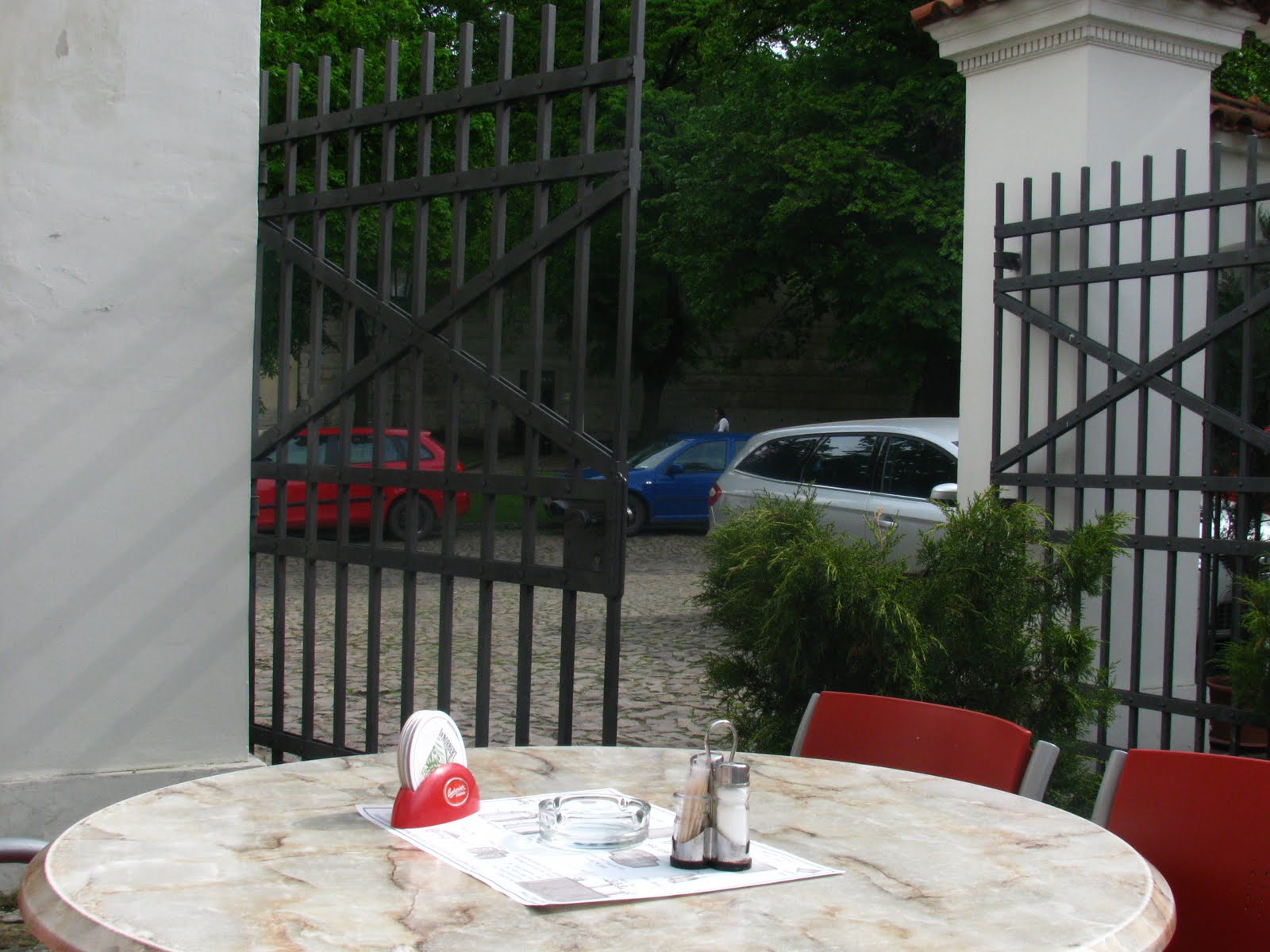
Today, the brewery and the restaurant are divided by a courtyard, and on a warm & sunny day, there's nothing better than kicking back with Norbert!


The pub...


Entrance to the Strahov Monastery complex...


Address:  Strahovské nádvoří , 301, Prague 1
Tram 22 or 23 to "Pohořelec"


Všechno nejlepší k svátku! (All the best for your name day, Medard!)

Today we honor Medard.  Happy Name Day, Medard!
Medard is of Czech origin meaning "great; strong".

Monday, June 7, 2010

Sunday, June 6, 2010

Today marks a very special day!

It's the one-year anniversary of my beloved cousin, Nadia, and her wonderful husband, Kurt.  Happy Anniversary you two!!!

And a very Happy Belated Name Day to:

May 28th: Happy Name Day, Vilém!  Vilém is the Czech form of William.  Vilem is of Germanic origin, meaning "will, desire + helmet, protection".

May 29th:  Happy Name Day, Maxmilián!  Maxmilián is of Latin origin, and its meaning is "greatest".

May 30th:  Happy Name Day, Ferdinand!  Ferdinand is of Old German origin, and its meaning is "bold voyager".

May 31st:  Happy Name Day, Kamila!  Kamila is a variant of Camilla, meaning "perfect".

June 1st:  Happy Name Day, Laura!  Laura is of Latin origin, and its meaning is "the bay, or laurel plant".  In classical times, a crown was made from the leaves of the bay laurel for heroes or victors as a symbol of honor and victory.

June 2nd:  Happy Name Day, Jarmil!  Jarmil is of Czech origin and is derived from the Slavic elements jary "fierce; strong" and mil "gracious; dear".

June 3rd:  Happy Name Day, Tamara!  Tamara is of Hebrew origin and its meaning is "date palm".

June 4th:  Happy Name Day, Dalibor!  Dalibor is of Slavic origin, and is derived from the Slavic elements dal meaning "far way" and borit meaning "to fight".

June 5th:  Happy Name Day, Dobroslav!  Dobroslav is a Czech and Slavic name of Slavonic origin.  The name means "good glory".

Všechno nejlepší k svátku! (All the best for your name day, Norbert!)

Today we honor Norbert.  Happy Name Day, Norbert!
Norbert is of Old German origin, and its meaning is "northern brightness".  St. Norbert was a 12th century German saint.